Keep it clean+Keep it cool=increased profitability
Integrated Solar Systems is building patent-pending, condition-based cleaning for utility-scale solar farms. Our machine-learning approach is designed to decide what to clean, when to clean it, and how, recovering yield that fixed schedules leave on the panel.
Patent Pending in the United States.
A pending U.S. patent covers our machine-learning control of nozzle output and boom carriage movement. We believe this is the only such filing in condition-based panel cleaning.
Condition-based, not calendar-based.
The technology is designed to decide per zone, per panel, per fluid, per pass, the boom acting only where the data says it should. Uniform cleaning gives way to intentional cleaning.
Verification by design.
Onboard cameras are built to re-scan each pass and confirm the clean before moving on, so every decision can be logged, every outcome audited, every cycle recorded.
It all reduces to one equation.
How It Works
Simplicity by Design
No need for a robot on every row.
One boom replaces robots on every row.
- Survey
- Set the track
- Mount the boom
- Connect the fluid
- System runs
One boom, two jobs, every panel.
These are renders of the patent-pending mechanism itself: the traveling gantry, the dual water lines, the spray nozzles, and the decision loop that tells them when to run. Every animation below plays on its own and opens full-screen.
Two waters, one traveling head.
A closer look at the cleaning head: spray nozzles reaching the full depth of the glass, fed by two separate lines: plain water for the cleaning wash, ionized water for the final rinse, shown cleaning two rows at once.
Linear system for traditional row-based solar farms · Concept render based on the patent drawings, not a built system.
Two-row gantry detail · separate wash + ionized-rinse lines
Open full-screen ↗One boom, sweeping the whole field.
A render of the radial center-pivot configuration described in the patent: a wheeled gantry sweeping the field on a fixed track, spraying as it travels. Switch it into cooling mode to see the same hardware protect panels on a hot afternoon.
Pivot-style system for circular solar installations · Concept render based on the patent drawings, not a built system.
Radial center-pivot embodiment · continuous loop, clean / cool modes
Open full-screen ↗A boom that rides above the rows.
The third patent-pending configuration, from Figs. 4 and 4a: an overhead rack on posts carries parallel gantry rails, and the spray boom travels along them on wheeled carriages, washing and rinsing every row in one pass while a flexible supply hose follows it. Panels are drawn flat, as in the filing's layout view.
Overhead gantry system for large-scale array coverage · Concept render based on the patent drawings, not a built system.
Overhead-rail embodiment per Figs. 4 + 4a · rail-riding boom, flex hose
Open full-screen ↗The cameras that watch for dirt also watch for people.
A software concept beyond the patent filing: the boom already carries a camera over every row to judge soiling. Pointed outward, the same network runs site security: it detects a person at the fence line, checks the authorized-crew list, warns on the spot with strobe and siren, activates lights over the area, and sends the clip with GPS to whoever should see it.
Concept illustration of a software feature beyond the patent filing, not a built system.
Security concept · detect, identify, warn, alert · no new hardware
Open full-screen ↗Designed for high-soiling environments.
The system is built for the climates that lose operators the most yield: dust-laden air, infrequent rain, hard water, long daylight cycles. Every input the patent describes is designed to be sampled in those conditions.
One controller, three regimes.
From the patent application: the model is designed to select between cooling water spray, light spray density, and heavy spray density, per zone, per panel, per cycle, using machine-learned activations of nozzle output and boom carriage movement.
- CoolingPulsed spray when panel temperature crosses a predetermined threshold.
- LightLow-density spray for routine condition-based passes.
- HeavyHigh-density spray for accumulated, high-loss soiling.
Technology and Licensing
Intelligent solar panel
cleaning technology.
Patent-Pending Automated Cleaning System for Utility-Scale Solar Farms
Mobile cleaning infrastructure, intelligent sensing, and machine-learning optimization, available for licensing, joint development, acquisition, or investment.
Development status: patent-pending intellectual property and design concepts only. No physical prototype has been constructed, tested, or deployed. Read the full disclosure
Clean panels earn.
Dirty panels do not.
The transition to renewable energy has created a growing need for efficient maintenance of large-scale solar installations. Dirt, dust, sand, bird droppings, leaves, snow, and other environmental contaminants can significantly reduce solar panel efficiency and power output. Existing cleaning approaches often require substantial labor, water usage, equipment, and operational downtime.
This patent-pending technology addresses that challenge through an automated solar panel cleaning system designed for utility-scale solar farms and large commercial solar installations. The invention combines mobile cleaning infrastructure, intelligent sensing, and machine-learning-based optimization to provide a potentially more efficient and cost-effective approach to solar panel maintenance.
One traveling boom,
three deployment formats.
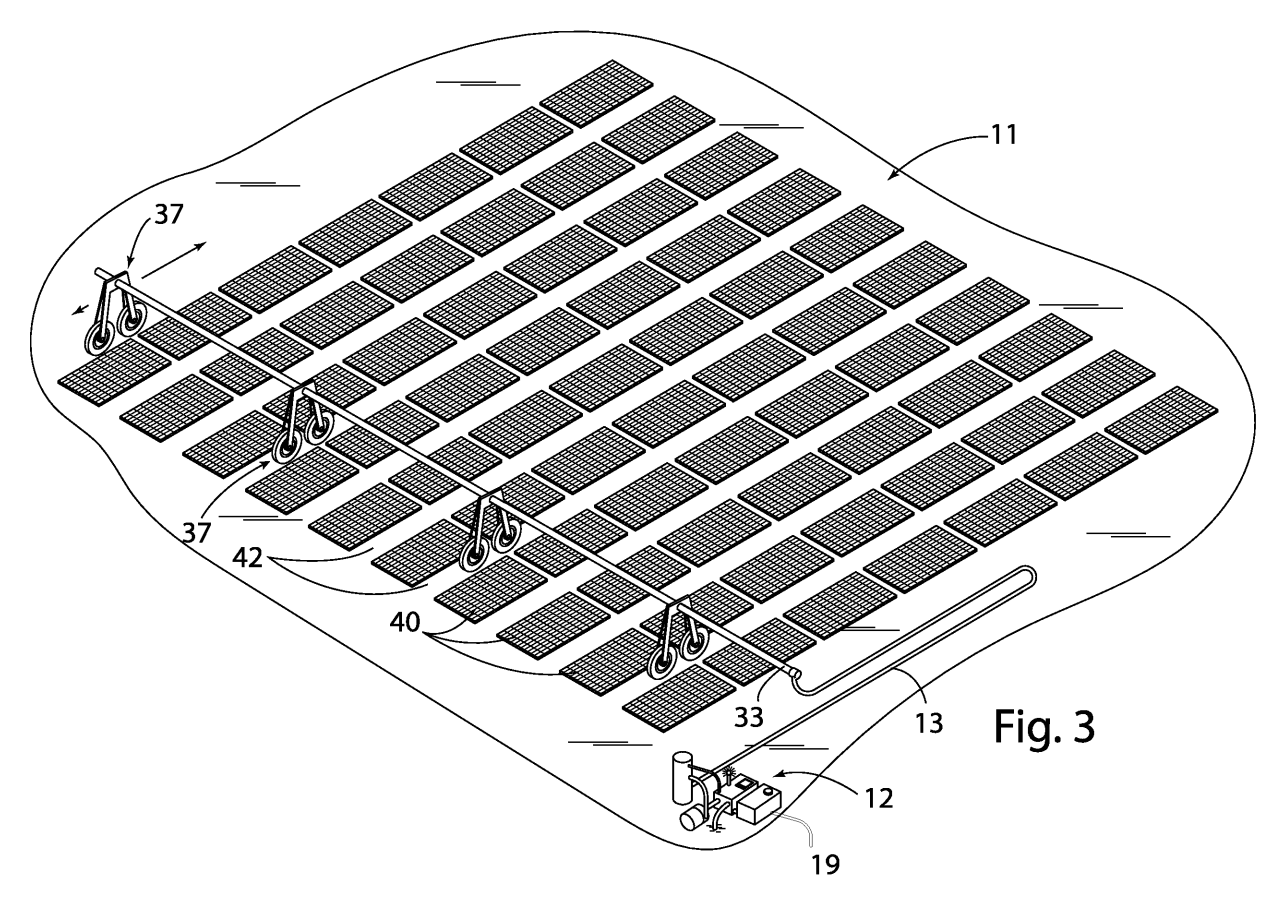
The patent-pending concept centers on a movable cleaning boom that travels over solar panel arrays while dispensing cleaning fluids through strategically positioned spray nozzles. The system may be configured in multiple deployment formats:
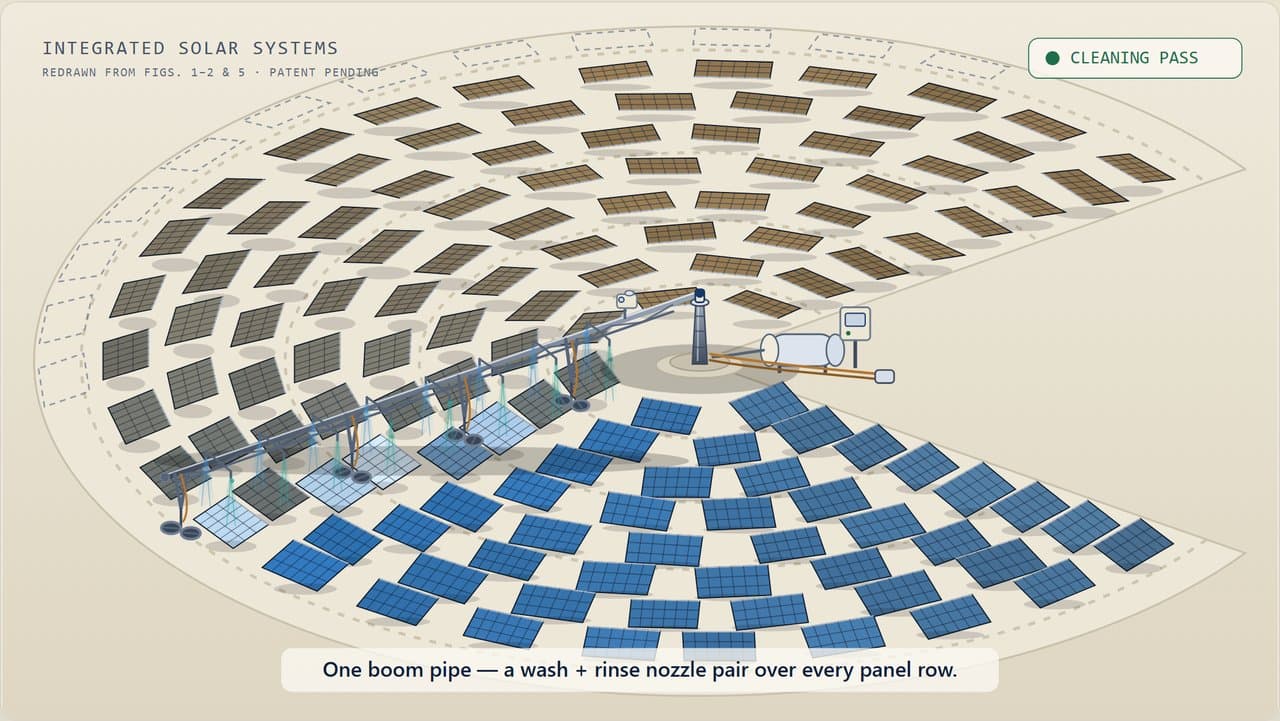
Pivot-style systems
A boom anchored at a central pivot station sweeps circular solar installations, covering the whole field from a single supply point.
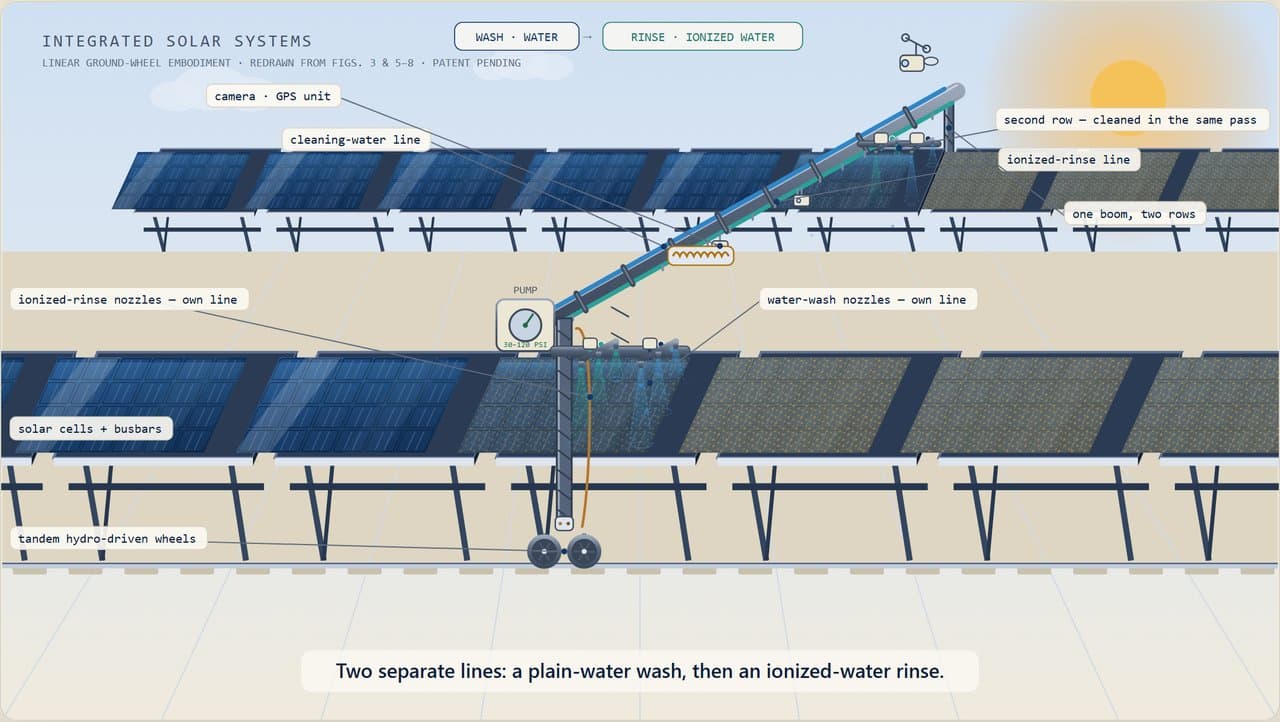
Linear systems
A wheeled boom travels along traditional row-based solar farms, washing and rinsing each row in a single pass.
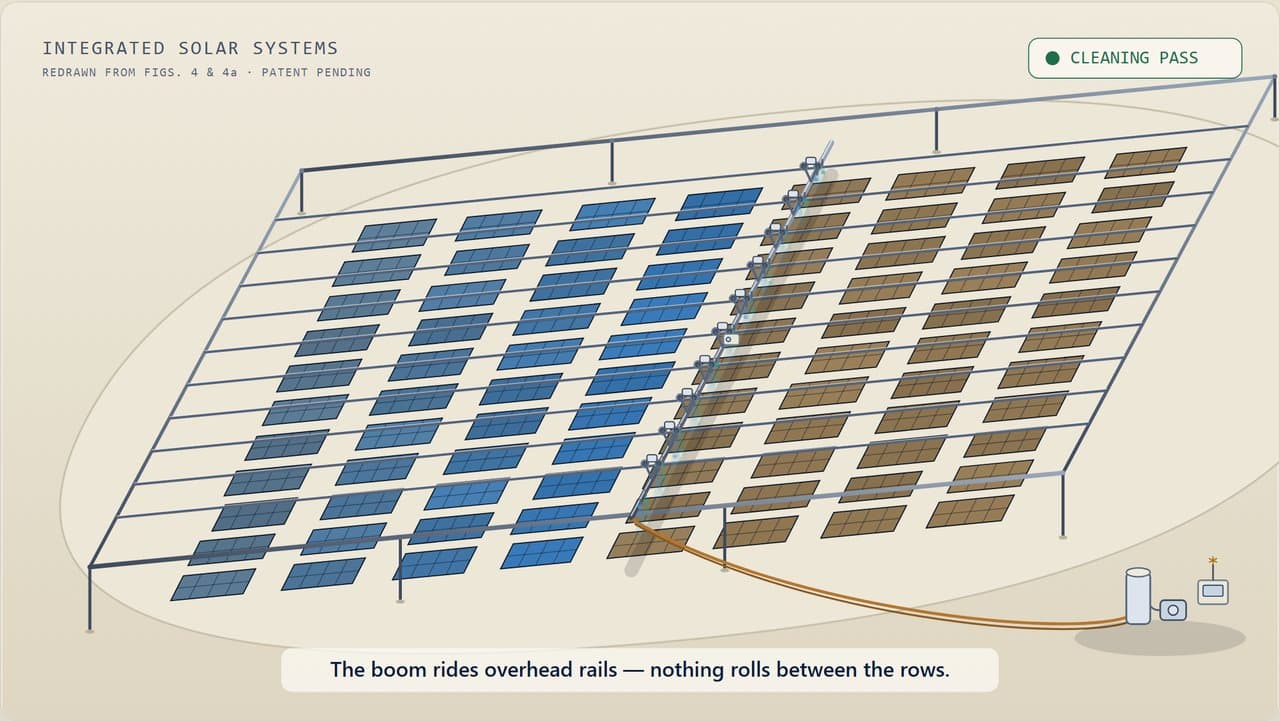
Overhead gantry systems
A rail-mounted boom rides an overhead rack above the arrays for large-scale coverage, with nothing rolling between the rows.
The technology integrates multiple data sources including cameras, weather sensors, temperature sensors, GPS positioning, power output monitoring, and forecasting services. These inputs enable the system to determine when cleaning is actually needed rather than relying solely on fixed maintenance schedules.
Representative system architecture is illustrated in the patent drawings: the application describes both radial and linear cleaning configurations. See all three configurations in motion.
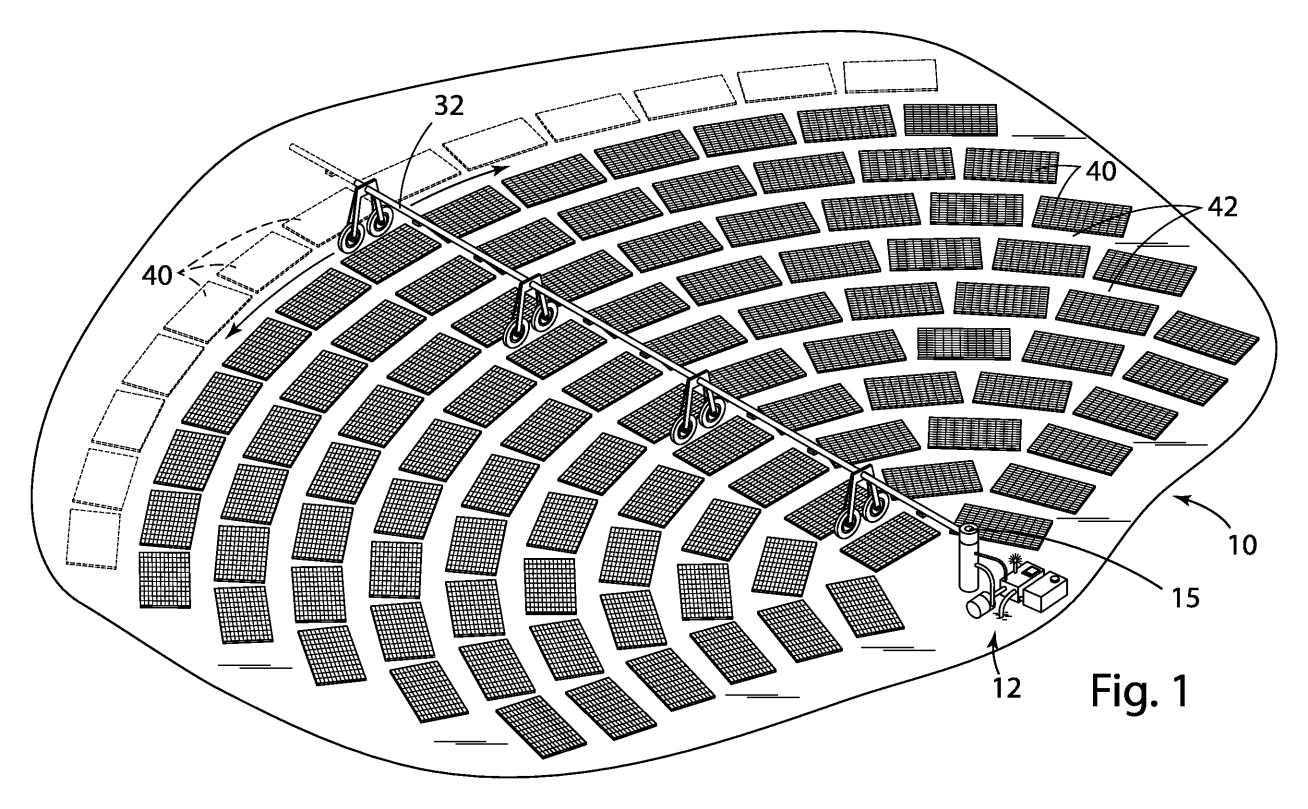
The innovation behind every cycle.
Our cleaning system is covered by a pending U.S. patent for the use of machine learning to control nozzle output and boom carriage movement in solar-panel cleaning. To our knowledge, it is the only such filing in the field of condition-based cleaning.
A machine-learning method for solar-panel cleaning.
Our patent-pending method is designed to control the cleaning system, panel by panel, using a predictive model rather than a fixed schedule.
- 01
Inputs the field actually gives you.
GPS, weather, image analysis, panel power output, cleaning regime, timers, manual input, and historical data.
- 02
A model that forecasts soiling losses.
The system predicts which zones lose the most yield next, and how much fluid and pressure will recover it.
- 03
Machine-learned activation of nozzles and boom.
Outputs are computed per zone, per pass: which nozzle fires, at what pressure, while the boom carriage moves at the chosen speed based on the system input and modeling.
A system designed
to learn over time.
A notable aspect of the invention is its use of machine learning to continuously improve cleaning effectiveness and resource utilization. The system is designed to analyze historical cleaning events, environmental conditions, camera imagery, and solar power output to optimize future cleaning operations. Potential benefits include:
- Reduced water consumption
- Lower operating costs
- Improved energy production
- Adaptive cleaning schedules
- Automated performance monitoring
- Predictive maintenance capabilities
The patent envisions a system that learns over time, helping operators determine the most effective cleaning strategies for specific climates, soil conditions, and installation types.
The work we filed,
in plain language.
Trust comes from being specific. Below are the patent claims that underpin our system: what we filed, when, and what each one covers.
Method to control a solar power cleaning system
Inputting GPS, weather, image analysis, panel power output, cleaning regime, timer, manual input, historical data, and predictive model value; activating scans and cleaning cycles; outputting machine-learned activations of nozzle output and boom carriage wheel movement.
Cooling cycle on temperature threshold
Determining whether the solar panels have reached a temperature above a predetermined threshold; activating a cooling water spray pulse in response to the affirmative determination.
Predictive model from collected field data
Entering variable data to a machine-learning database; collecting and storing field data for each system input; defining data set characteristics; creating a predictive model based on datasets for selected desired outputs.
Built for the people
who run solar at scale.
Potential markets include:
- Utility-scale solar farms
- Commercial rooftop solar installations
- Industrial renewable energy facilities
- Solar developers and EPC contractors
- Independent power producers
- Solar asset management companies
As global solar capacity continues to expand, automated maintenance technologies may play an increasingly important role in maximizing energy production and reducing operating expenses.
Three trends,
one machine.
The technology seeks to combine three increasingly important trends in renewable energy operations:
- 01
Automation of labor-intensive maintenance activities
Designed to replace manual washing crews, water trucks, and scheduled downtime with automated cleaning infrastructure.
- 02
Data-driven operational decision making
Designed so that cameras, weather sensors, GPS, and power output monitoring decide when cleaning is actually needed, not the calendar.
- 03
Artificial intelligence optimization of asset performance
Machine-learning models are designed to tune each cleaning cycle to the site's climate, soil conditions, and production data.
By integrating cleaning hardware with sensor-driven analytics and machine-learning models, the invention aims to create a smarter approach to maintaining solar energy production across large installations.
Where the technology
stands today.
This technology currently exists as patent-pending intellectual property and design concepts described in the patent application. No physical prototype has been constructed, tested, or commercially deployed to date. Performance expectations and commercial benefits are based on the concepts and embodiments disclosed in the patent application and have not yet been validated through field trials.
The owner of this intellectual property is actively exploring strategic opportunities with solar industry participants, equipment manufacturers, automation companies, renewable energy investors, and strategic acquirers.
- Solar industry participants
- Equipment manufacturers
- Automation companies
- Renewable energy investors
- Strategic acquirers
- Exclusive or non-exclusive licenses
- Joint development arrangements
- Strategic partnerships
- Asset acquisition transactions
- Outright purchase of the patent portfolio
Organizations interested in evaluating the technology, discussing commercialization pathways, or negotiating licensing or acquisition opportunities are invited to make inquiry.